A Completed Training Record Does Not Prove Competence
By Melita Ball
FDA says training effectiveness should be proportionate to risk. A completion check or quiz may be enough for some work, but not for every regulated task.
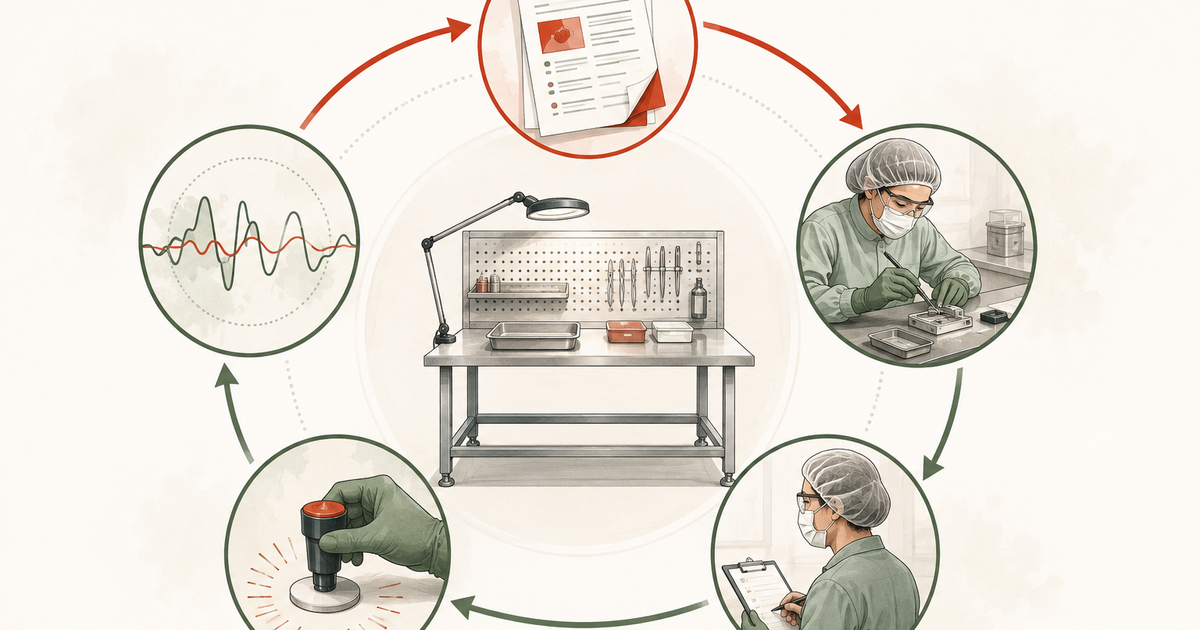
A learning-management system can tell you that an employee opened a course, reached the last screen, passed a quiz, and signed the record. It cannot tell you, by itself, whether that employee can perform the work correctly when product quality depends on it.
FDA made the distinction unusually clear during its 2026 town hall on QMSR risk-based inspections. Discussing competence under ISO 13485, the agency said manufacturers must evaluate the effectiveness of actions taken to achieve or maintain competence. The method should be proportionate to the risk of the work. For higher-risk processes, FDA identified supervisor evaluations, skill assessments, practical demonstrations, and ongoing performance monitoring as possible evidence beyond a simple quiz.
That is not an instruction to build the same elaborate assessment for every procedure. It is an instruction to use judgment.
Completion and competence answer different questions
Training completion answers an administrative question: did the assigned person complete the required activity by the required date?
Competence answers an operational question: can the person apply the necessary knowledge and skills to achieve the intended result?
Both records matter. Confusing them creates a weak system.
A completion record may be appropriate evidence that someone received a policy update. It may be poor evidence that an operator can set up a validated process, that a complaint investigator can distinguish a reportable event, or that an inspector can recognize an out-of-tolerance condition.
The evidence method should follow the work. Start by defining the intended competent performance in observable terms. "Understands the procedure" is difficult to assess. "Selects the current drawing, verifies the correct fixture, completes the setup checks, and recognizes the defined stop conditions" gives a supervisor something real to evaluate.
Start with the work and its risk
Do not assign training methods from document type alone. The same procedure can contain tasks with very different consequences.
For each role or task, consider:
- What can go wrong if the work is performed incorrectly?
- Can the error be detected before the product, data, or decision moves forward?
- How complex or variable is the task?
- How frequently does the person perform it?
- Is the task new to the person or newly changed?
- What education, experience, or qualification already supports competence?
Use those answers to assign an evidence tier. The tier is not a grade for the employee. It is the organization's decision about how much evidence is needed to trust the competence conclusion.
A low-risk administrative change may need acknowledgement and a short knowledge check. A moderately complex controlled process may need a scenario or supervised observation. A high-risk practical task may need demonstration on representative work, defined acceptance criteria, and follow-up performance monitoring.
Document why the selected method fits the risk.
Match the evidence method to the task
There is no single best training-effectiveness test. The method has to reveal whether the person can do the actual work.
Lower-risk knowledge work
For a policy, terminology update, or low-risk administrative process, a focused quiz or scenario may be enough. Avoid questions that test memory of sentence fragments. Ask the learner to recognize the right decision or locate the controlled source.
If the correct behavior is to consult a current requirement rather than memorize it, test retrieval and application. That is closer to the real task.
Controlled procedural work
For complaint intake, document approval, supplier-record review, labeling reconciliation, or similar work, use case-based assessment. Give the person a representative record and ask them to complete the decision path.
The assessor should use predetermined criteria. Did the person select the right procedure? Identify missing information? Escalate the case? Document the rationale? Route the work to the right owner?
Retain the result, not a surveillance transcript. The evidence should show what was assessed, who assessed it, the outcome, gaps, and any follow-up action.
High-risk practical work
For aseptic activities, equipment setup, inspection, testing, software release, sterilization support, or other tasks where an error could directly affect product quality or patient risk, practical demonstration may be necessary.
Observe the work under representative conditions. Include foreseeable difficulties and defined stop conditions. Confirm that the person can recognize abnormal results, protect product status, and escalate correctly, not merely repeat the normal sequence.
Then monitor early performance. A successful demonstration on Tuesday does not guarantee reliable performance across the next month. Review a defined number of completed records, first-piece results, deviations, or supervisor observations. Close the competence action when the evidence shows stable performance.
Build effectiveness into the change workflow
Training often becomes a final checkbox in document control. A procedure is approved, assignments are issued, and the change is considered implemented when everyone completes the course.
Move the competence decision earlier. During change assessment, identify the roles affected, the behaviors that must change, the risk of incorrect performance, the training method, the effectiveness method, and the evidence owner.
This prevents a familiar failure: the team launches a revised process before deciding how it will know whether the change worked.
For significant changes, separate authorization from effectiveness. A person may be authorized to perform work after supervised qualification, while the organization continues monitoring effectiveness over a defined period. Record both states so supervisors know who can perform the task and which competence evidence remains open.
The system should also handle contractors, temporary staff, transferred employees, and infrequent tasks. A person who was qualified two years ago but has not performed the task since may need a different readiness check than someone who performs it every day.
Use performance signals without turning every error into retraining
Deviations, nonconformances, complaint errors, audit findings, rework, and supervisor observations can reveal competence gaps. They do not prove that training was the cause.
When a performance problem occurs, assess the system around the person. Was the procedure clear? Was the correct tool available? Did the interface invite the wrong selection? Was workload unrealistic? Did the process change without an updated job aid? Was the person assigned work outside the qualification scope?
Retraining is appropriate when a knowledge or skill gap contributed to the problem. It is weak corrective action when the process design caused the error.
Connect the signal to the competence record, document the assessment, and choose the action that addresses the cause. That action may be coaching, supervised practice, a clearer procedure, a system change, different staffing, or a formal qualification step.
Make competence visible at the point of work
Supervisors need a current answer to a practical question: who is qualified to perform this task today?
That answer becomes unreliable when procedures, training assignments, qualification results, role changes, and equipment authorizations sit in separate files. A person may appear current in the learning system while a practical assessment is overdue or the procedure version has changed.
Connected compliance infrastructure changes the handoff. A document revision can identify affected roles, assign the right learning and assessment methods, capture supervisor evidence, update authorization status, and connect later performance signals to the original change.
IntelaSolve includes training records and competencies within a broader eQMS that also connects document control, change control, CAPA, supplier management, design, operations, and post-market work. For device teams adapting to the current inspection model, the QMSR inspection-readiness article provides the broader context.
Start with one high-risk work instruction. Define what competent performance looks like, choose evidence proportionate to the risk, and decide who can make the competence conclusion. That exercise will tell you quickly whether the current training system measures attendance or supports reliable work.
Sources
Topics
- MedTech
- QMSR
- Training Effectiveness
- Workforce Competence