The First Compliance Platform Decision Should Follow the Product
By Melita Ball
A first-device company does not need every enterprise process on day one. It does need a system that keeps the product, evidence, quality work, and changes connected as the company grows.
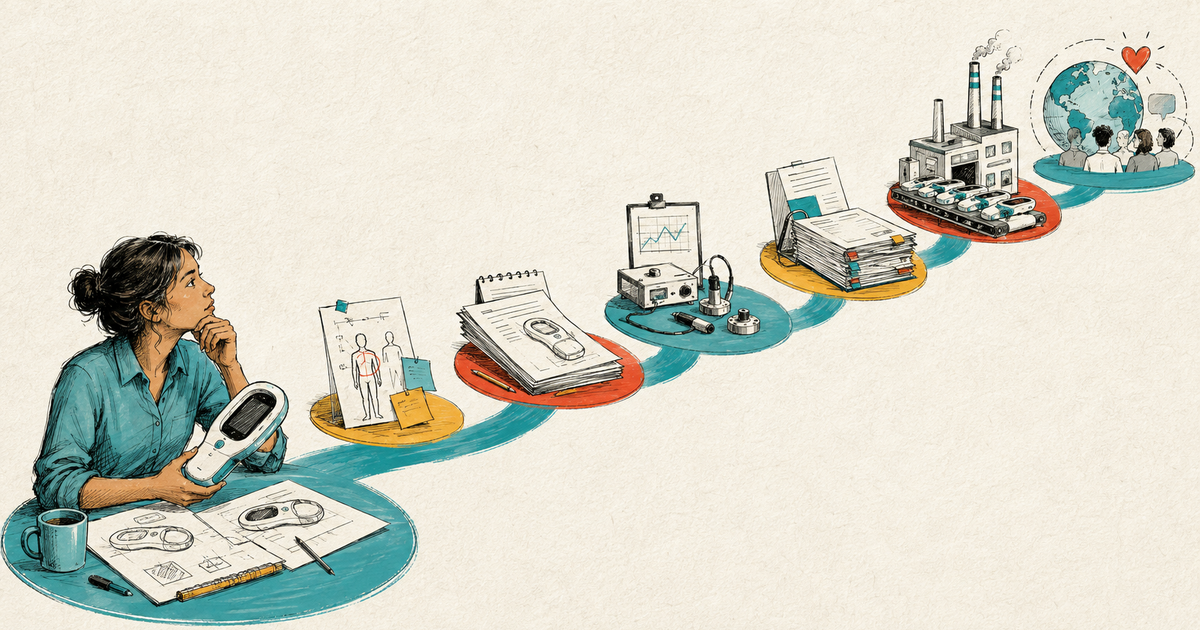
A first-device company can buy compliance software too early and still buy it too late.
It buys too early when the selection is based on a generic module checklist before the team understands the product, regulatory path, evidence plan, and operating model. It buys too late when design decisions, risks, supplier records, testing, and submission content already live in separate files with no controlled relationship between them.
The right starting point is the device.
The software decision should follow the work required to define, develop, support, manufacture, submit, and monitor that product. The company can enable capabilities in phases, but the underlying structure should protect the evidence chain it will depend on later.
Your first software decision is an operating-model decision
Founders often ask when they should implement an eQMS. The calendar is not the best guide.
The better question is whether the team has begun making regulated product and quality decisions that must remain controlled, traceable, and usable by more than one function. Once product definition, design, risk, suppliers, testing, regulatory strategy, or quality records begin to depend on one another, the operating model matters.
A modern electronic quality management system can provide real value. It can control documents, training, CAPA, audits, suppliers, and changes. Those processes matter.
A first-device team should also ask what happens to the work outside those quality modules. If intended use sits in a product file, design inputs in another tool, risks in a spreadsheet, verification evidence in shared storage, and regulatory decisions in email, the company may establish a digital QMS while leaving the product lifecycle manual.
That architecture can work for a while. The cost appears when a change forces the team to trace the relationships under deadline.
Start with the device, not the module list
Before comparing software, define the product story the system must support.
At a minimum, the team should understand the intended use, intended users, use environment, core claims, likely product variants, initial markets, major technical risks, development approach, and regulatory strategy. Some conclusions will still be developing. That is normal.
The point is to establish a controlled product definition that other work can reference.
Then map the decisions and evidence that will grow around it:
- design and development planning;
- user and product requirements;
- design outputs;
- risk analysis and risk controls;
- verification and validation evidence;
- clinical or performance evidence where applicable;
- suppliers, materials, and external development work;
- manufacturing and acceptance processes;
- regulatory strategy and submission content;
- labeling, registration, and market commitments; and
- complaints, reportability, corrective action, and postmarket work.
This map gives the software evaluation a purpose. The team is no longer asking which vendor has the longest feature list. It is asking whether the selected infrastructure can preserve the relationships the first product will create.
Phase one: establish the controlled foundation
An early team does not need a mature enterprise process for every future activity. It does need clear ownership and basic control.
The first phase should establish how approved documents are created and changed, how responsibilities are assigned, how training or competence records are handled where needed, how decisions are approved, and where the current product and regulatory definitions live.
Keep the process proportionate. A five-person company should not imitate the administrative structure of a global manufacturer. It should still be able to answer basic questions without ambiguity:
- Which version is current?
- Who approved it?
- What product or process does it affect?
- What changed?
- Which work must be revisited because of that change?
- Where is the supporting evidence?
- Who owns the next decision?
Software that makes these answers difficult is not a good early foundation, even if it offers many modules.
Phase two: connect design, risk, and evidence
As development progresses, the evidence chain becomes the center of the system.
Design inputs should relate to the outputs intended to satisfy them. Risks and risk controls should remain connected to the design and to the verification that shows the controls were implemented and evaluated. Changes should identify the affected requirements, risks, tests, suppliers, labels, and regulatory assumptions.
This is where first-device companies accumulate expensive compliance debt. The team moves quickly, so a change is discussed in a meeting and reflected in the design. The risk file is updated later. A verification protocol still refers to the earlier configuration. A submission writer eventually has to discover which version tells the current story.
The problem is not a lack of effort. It is an architecture that asks people to maintain the same relationship manually in several places.
During a software demonstration, ask the vendor to show how one product change moves through the design, risk, evidence, and approval chain. Do not accept a folder tour as proof of traceability.
Phase three: prepare suppliers and manufacturing
A first-device team often depends heavily on external design, testing, component, and manufacturing partners. Software selection should account for that operating reality.
The company needs to control supplier qualification and performance, specifications, change notifications, incoming or acceptance activities, nonconformances, and the transfer of approved design information into production. The exact process will depend on the device and business model.
The critical buying question is whether supplier and manufacturing evidence remains related to the product configuration it supports.
If a supplier changes a material, can the team identify the affected design outputs, risk controls, verification, process documentation, and regulatory conclusions? Can it see whether the change was approved before the affected configuration moved forward?
A supplier record stored inside a QMS is useful. A supplier record connected to the product decisions it can change is more useful.
Phase four: preserve continuity through submission and market
Submission preparation should not create a separate product story.
Regulatory teams need to assemble evidence around the same intended use, design, risks, performance, labeling, manufacturing, and quality decisions used during development. Once the device reaches the market, registration data, complaints, field information, reportability assessments, CAPA, and product changes should continue that record.
A platform does not eliminate the need for qualified judgment. It should make the evidence behind that judgment easier to find and keep current.
This continuity matters to founders because early decisions have a long life. A claim added during development can affect testing and labeling. A supplier change can affect risk and submission strategy. A complaint can reveal a design or process question that reaches back into development records.
The system should help the team follow those relationships without rebuilding them every time.
Decide what can wait
A staged implementation is often appropriate. The company may not need advanced multi-site governance, complex portfolio reporting, mature supplier scorecards, or every postmarket workflow at the beginning.
What should not wait is the definition of ownership and the structure of the product evidence chain.
The team should know which record controls the product definition, how changes are approved, where design and risk relationships are maintained, how supporting evidence is associated with the correct configuration, and how regulatory consequences are assessed.
This is the difference between delaying a capability and creating a manual handoff that later has to be replaced.
When evaluating scope, ask vendors to distinguish three things:
- Capabilities the team needs immediately.
- Capabilities that can be enabled as the product advances.
- Lifecycle relationships that must exist from the beginning even if one side of the relationship develops later.
A good buying process produces a phased operating model, not a promise to implement everything at once.
Test the platform with one realistic change
Feature checklists make many systems look similar. A change scenario exposes the operating model.
Use a hypothetical but realistic case: a critical supplier proposes a material change after design verification has started but before submission. Ask the vendor to show how the platform would help the team identify affected specifications, design inputs and outputs, risk controls, verification evidence, supplier records, labeling, submission content, training, and approvals.
Then ask:
- Where is the authoritative product configuration?
- How are affected records identified?
- Can owners see the same change from their functional view?
- What evidence shows that impact assessment and approvals were completed?
- How does the team distinguish planned work from completed evidence?
- What must be exported, reconciled, or re-entered in another system?
- Which parts of the scenario depend on custom work outside the platform?
The answers will tell the founder more than a polished dashboard.
Where IntelaSolve fits
IntelaSolve's verified eQMS and compliance-platform model includes core quality processes such as document control, CAPA, training, supplier management, audits, and change control. It extends beyond quality into connected lifecycle work spanning R&D, design controls, risk management, clinical operations, regulatory strategy and submissions, manufacturing and operations, and postmarket surveillance.
That distinction matters for a first-device team. The company is not replacing an established stack. It is deciding what kind of stack to create.
IntelaSolve's founder compliance path is designed for teams launching a first medical device or Life Sciences product. The medical-device compliance platform provides the category detail founders can use to compare lifecycle scope with a quality-only approach.
The right platform does not make the regulatory or technical decisions. It gives qualified people a controlled infrastructure in which those decisions, their evidence, and their downstream effects can remain connected.
Before buying software, map one product change from the person who proposes it to the records, evidence, approvals, and market decisions it could affect. That map will show what the team needs now, what can wait, and where a manual handoff would create debt from the first device forward.
Complete a founder compliance-readiness analysis focused on the first device's evidence chain and phased software needs.
Frequently asked questions
- When should a medical device startup implement an eQMS or compliance platform?
- The decision becomes pressing when regulated product and quality records begin to depend on one another and the team needs controlled ownership, approvals, change history, and cross-functional traceability.
- Does a first-device company need every compliance software module immediately?
- Usually not. Teams can enable processes in phases, but should establish product definition, ownership, document and change controls, and evidence relationships early enough to avoid rebuilding them later.
- What should founders test during a compliance software demonstration?
- Use one realistic product-change scenario and ask the vendor to show how the system identifies affected design, risk, supplier, testing, regulatory, quality, and approval records.
Topics
- Medical Device
- Founders
- Compliance Platform
- eQMS