
Ebola Readiness Begins Before FDA Activates the Questions
FDA's updated Ebola guidance for blood establishments separates always-on preparedness from outbreak-triggered controls. Learn how to build activation control, deferral logic, product traceability, and deviation reporting.
The guidance creates an activation problem
FDA updated its final guidance on blood donor eligibility, donor deferral, and blood product management in response to an Ebola disease outbreak in June 2026. The guidance confirms FDA’s determination that Ebola disease is a transfusion-transmitted infection under 21 CFR 630.3(l) and applies to blood establishments collecting blood and components for transfusion or further manufacture, including Source Plasma.
The updated guidance is nonbinding except where it cites requirements. It also creates an operational distinction that deserves attention: some preparedness elements are always relevant, while specific outbreak questions and deferrals are activated when FDA communicates that they should be implemented and identifies the countries for which residence and travel history should be assessed.
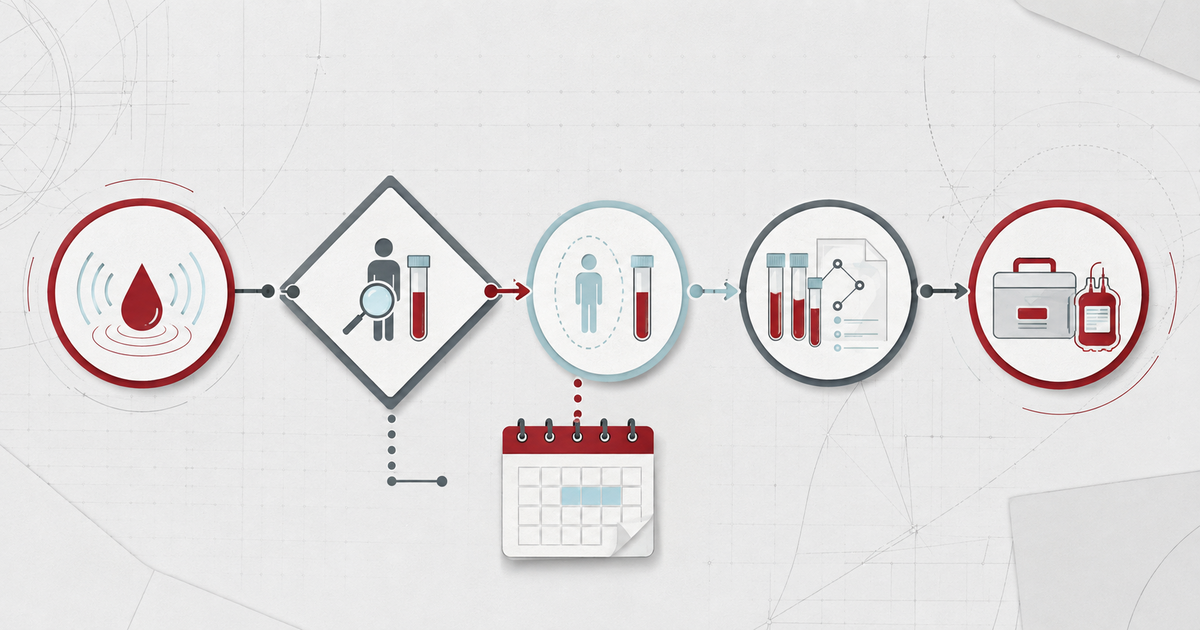
That means readiness cannot begin with a last-minute form edit. The organization needs a controlled way to receive the signal, interpret it, update donor workflows, train staff, apply deferral logic, connect a later donor finding to distributed products, and preserve evidence of every action.
Separate always-on controls from outbreak-triggered controls
FDA recommends that donor educational materials instruct individuals with a history of Ebola disease not to donate, even when no country has an active outbreak. This is an always-on preparedness control.
During an outbreak, and when FDA communicates implementation, the donor history questionnaire and accompanying materials must incorporate elements that assess recent or current illness and travel to or residence in an endemic area under the cited donor-eligibility requirements. FDA also recommends questions addressing Ebola history, residence or travel in the prior eight weeks to an identified outbreak country, close contact in the prior eight weeks, certain sexual contact, and notification by a public health authority of possible exposure.
Build two controlled states for the workflow. The baseline state contains standing education and standard health screening. The activated state adds the current FDA-specified countries, questionnaire content, deferral logic, staff instructions, escalation contacts, and effective time.
Name the role authorized to activate and retire the outbreak configuration. Require source verification and a documented effective date. Preserve the prior configuration so the establishment can show which questions and rules were active for a donation on a particular day.
Translate eight-week rules into system logic
FDA recommends indefinite deferral for a donor with a history of Ebola disease, excluding the separate context of convalescent plasma addressed in the guidance. It recommends an eight-week deferral after departure for residence or travel in an identified outbreak country.
The guidance also recommends eight-week deferrals after the last close contact with a confirmed case or person under investigation, after the last specified sexual contact with a person known to have recovered, and after an exposure identified by a public health authority.
These rules need precise data fields. Capture the risk type, relevant country, departure or last-contact date, source of the information, calculated deferral end, reviewer, and final eligibility decision. A free-text note makes consistent calculation and later retrieval difficult.
Test boundary conditions. Confirm how the system handles incomplete dates, a person under investigation whose status changes, a country added to or removed from FDA’s communicated list, overlapping risk factors, and a donor who presents before a deferral expires.
Training should cover both the rule and the escalation path. Front-line staff should not improvise when the donor’s history does not fit a clean scenario.
Connect donor findings to product action
The guidance extends well beyond the donor decision. If an establishment collected blood or components from a donor who should have been deferred for residence, travel, or close-contact risk, FDA recommends quarantining and destroying undistributed in-date components. For distributed components, the guidance recommends notifying consignees to retrieve, quarantine, and destroy the affected in-date products.
An exception is described for certain plasma already pooled for further manufacturing into products made with multiple validated viral inactivation and clearance steps shown to be robust for lipid-enveloped viruses. That exception is specific and should not become a generic no-action rule.
When a donor is later determined to have Ebola disease, FDA recommends contacting the agency as soon as possible. The guidance addresses components collected in the eight weeks before disease onset and any time after onset, along with retrieval, quarantine, recipient-related communication, and risk analysis for pooled plasma or released finished products.
Manufacturers should build a trace from donor to collection, component, pool, finished product, consignee, and disposition. The decision record should identify which guidance scenario applies, what product scope was found, what was quarantined or retrieved, who was notified, and what risk analysis supports the outcome.
Make deviation reporting visible
The guidance points to biological product deviation reporting requirements when affected blood, components, or finished products have been distributed. It recommends reporting as soon as possible and cites a maximum of 45 calendar days from obtaining information reasonably suggesting that a reportable event occurred under the applicable regulations.
Do not let that clock live only in regulatory affairs. The event intake should capture the awareness date, reportability assessment owner, due date, submission evidence, and any linked investigation or CAPA. When the facts change, the record should show who reassessed the decision.
Run an end-to-end tabletop exercise
Use a plausible fictional scenario without implying a current outbreak. Begin with a verified FDA activation communication. Ask the team to update the country list and questionnaire, calculate a deferral, identify a donation collected before the update, trace an in-date component to a consignee, place inventory on hold, draft the notification, evaluate a pooled-plasma scenario, and assess deviation reporting.
Include donor operations, IT, quality, medical affairs, laboratory, inventory, distribution, regulatory affairs, and communications. Time each handoff. Record missing data, unclear authority, inaccessible contact lists, and uncontrolled documents.
Then remediate the workflow and repeat the exercise. A useful test ends with retrievable evidence, not a discussion of what participants believe they would do.
Organizations operating across jurisdictions can connect the exercise to IntelaSolve’s markets overview. A connected eQMS can help link the activation record, donor decision, product trace, investigation, notifications, and reporting evidence.
Preparedness is a quality-system capability
The updated FDA guidance is not a statement that a new outbreak is occurring. It is a current framework for what blood establishments should be ready to do if FDA activates outbreak-specific recommendations.
The operational lesson is broader. Rare events expose the quality of configuration control, traceability, escalation, and evidence retrieval. Preparing those capabilities before the signal arrives gives the establishment a much better chance of acting consistently when time matters.
Schedule a focused strategy call to tabletop one blood-establishment response scenario and identify the weakest evidence handoffs before activation is needed.