
Cybersecurity Evidence Has to Survive the Next Release
Connected-device cybersecurity evidence decays when ownership is fragmented. Learn how to maintain a living evidence set covering baselines, vulnerability decisions, update and disclosure records, and retrieval testing.
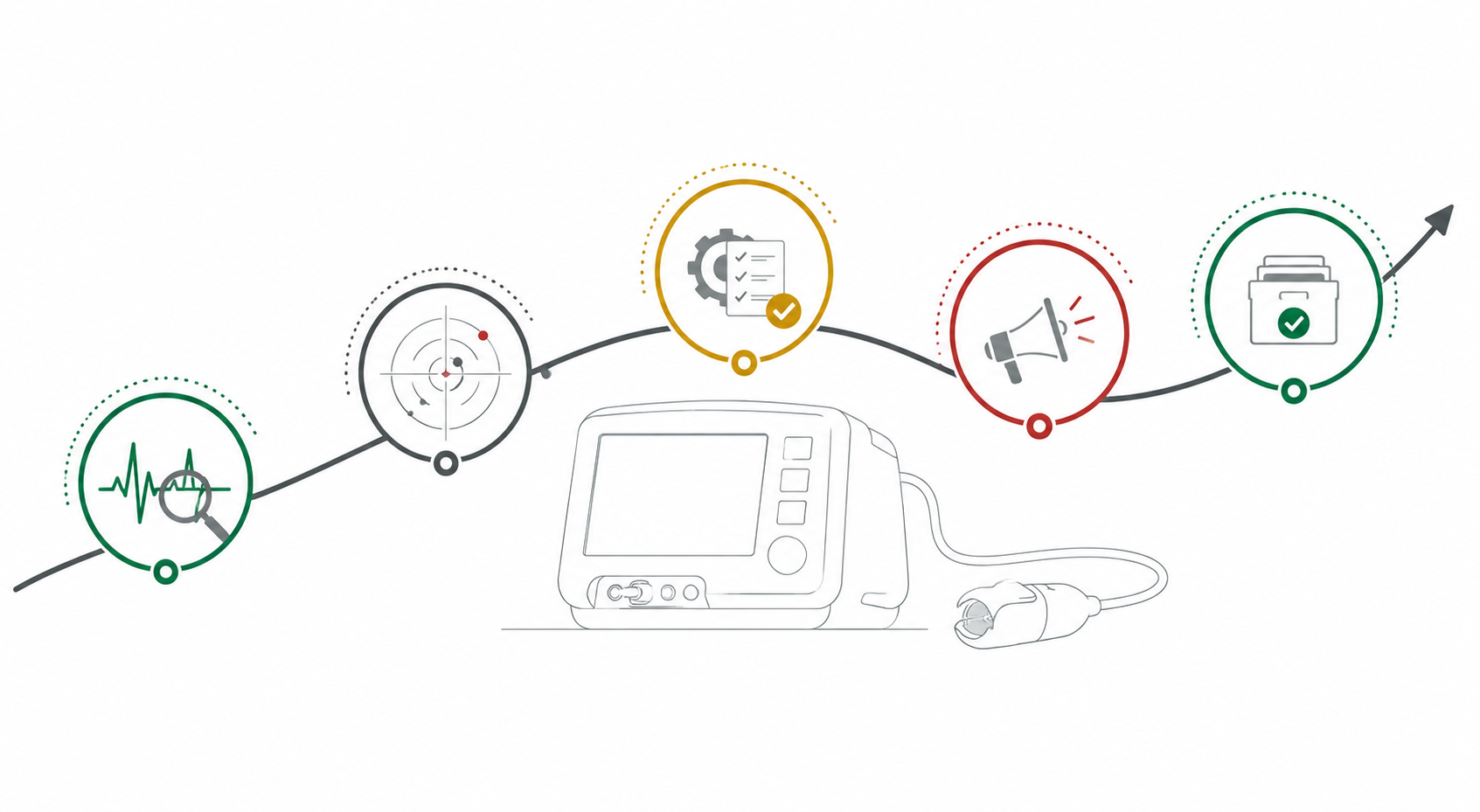
Cybersecurity evidence decays when ownership is fragmented
Connected-device security does not stop when a product reaches the market. New vulnerabilities appear, third-party components change, deployment environments evolve, and manufacturers make software updates. The technical work may be active while the regulated evidence quietly falls out of alignment.
One team monitors vulnerability feeds. Another maintains the software bill of materials. Engineering tests fixes. Quality opens records only for selected events. Regulatory affairs becomes involved when a submission or report is considered. Customer support holds field context. If those activities are not connected, the manufacturer may struggle to explain what it knew, how it evaluated a signal, why it chose an action, and which product versions were affected.
A living cybersecurity evidence file solves a retrieval and decision problem. It does not need to be one physical file. It needs a controlled index that connects authoritative records across systems and preserves the reasoning behind consequential decisions.
Define the living evidence set
Build the evidence model around the product lifecycle and the questions a reviewer will ask. What product and software configuration was in scope? What signal was received? How credible and relevant was it? What was the potential safety and security impact? What action was selected? How was that action verified, released, communicated, and monitored?
Product and environment baseline
Maintain a current baseline for each supported product version. Include software and firmware versions, significant third-party components, supported configurations, network assumptions, security controls, update mechanisms, support periods, and known deployment constraints.
The baseline should distinguish what the manufacturer controls from what depends on the user environment. That distinction supports clearer risk analysis and communication. It also prevents an assessment for one configuration from being applied too broadly to another.
Changes to the baseline should be traceable. A new library, operating-system dependency, cloud service, or communication protocol can change the vulnerability surface even when intended clinical functionality remains the same.
Vulnerability and threat decisions
For each relevant signal, capture the source, date received, affected component or function, product applicability, exploitability assessment, potential safety impact, existing controls, uncertainty, and assigned owner. Record why the signal was closed, monitored, escalated, or remediated.
Scoring tools can support prioritization, but a numeric score should not replace device-specific analysis. A vulnerability with moderate general severity may matter more in a safety-critical workflow or in a configuration with weak compensating controls. Conversely, a widely publicized issue may not affect the device configuration in question. The record should show the product-specific reasoning.
Update and disclosure records
When remediation is selected, connect the vulnerability assessment to design inputs, risk controls, implementation, verification, regression testing, release approval, distribution, customer communication, and effectiveness monitoring. Identify the exact versions affected and the versions containing the fix.
When no update is released, preserve the rationale and any compensating measures. When disclosure or coordinated communication is appropriate, retain approved content, timing decisions, affected audiences, and follow-up actions. The evidence should show a coherent chain, not a collection of isolated security tickets.
Connect security work to quality-system decisions
Cybersecurity signals can intersect with complaint handling, nonconformance, corrective action, design change, risk management, field action, regulatory reporting, and supplier controls. Define criteria for those intersections so the handoff does not depend on personal familiarity.
For example, a product-security assessment may determine that a vulnerability is technically valid and product-relevant. A quality decision then considers whether the issue represents a product nonconformity or requires corrective action. A safety assessment considers potential harm. Regulatory owners assess reporting and submission implications. The workflow should preserve each distinct decision and its basis.
Supplier evidence also belongs in the chain. Manufacturers need a method for receiving component notices, determining product applicability, obtaining remediation information, and tracking supplier response. Contract language matters, but operational routing matters just as much.
Use cadence and triggers
Combine scheduled review with event-driven triggers. A routine cadence can confirm supported versions, component inventories, unresolved vulnerabilities, expiring support, open remediations, customer communications, and monitoring trends. Event triggers can respond to a new exploited vulnerability, supplier notice, field incident, major architecture change, or evidence that an existing control is ineffective.
Assign owners and time expectations by risk tier. Also define what pauses a planned release. An unresolved high-impact dependency or incomplete regression evidence should not be discovered during final approval.
Metrics should illuminate process health without creating false assurance. Useful measures may include age of unresolved product-relevant signals, time to applicability decision, overdue remediation actions, supported versions without a current baseline, and percentage of released fixes with completed effectiveness review. Interpret trends alongside risk and workload.
Test retrieval, not just completion
Select one recent vulnerability and ask an independent reviewer to reconstruct the decision. Can the reviewer identify the affected products, baseline, assessment, risk link, chosen action, test evidence, approvals, communication, and follow-up? Can the record explain why other versions were excluded? Are referenced records controlled and accessible?
Retrieval testing exposes broken links that completion checks miss. It also gives the organization a realistic view of readiness for the next submission, inspection, customer question, or urgent field decision.
The durable goal is simple: security teams should be able to move quickly without leaving quality and regulatory evidence behind. A living evidence structure keeps the technical response and the regulated decision in the same story.
FDA's current medical-device cybersecurity guidance and section 524B make the lifecycle connection especially important for cyber devices. Related IntelaSolve resources on risk-based software assurance, recall readiness, and a medical-device eQMS can help teams test whether the evidence remains connected across systems.
Define when cybersecurity evidence becomes stale
A record can be complete and still be out of date. Set review triggers for new vulnerabilities, component updates, changes in exploitability, architecture changes, new compensating controls, and field information that alters the original risk assessment. Each trigger should identify the owner, the evidence to reopen, and the decision that must be refreshed.
Time-based review also matters for assumptions that may not generate a discrete alert. Examples include support status for third-party components, monitoring coverage, patch availability, customer communication channels, and the continued effectiveness of a mitigation. A controlled review calendar helps the team find expired assumptions before the next release or submission.
The useful question is not whether a cybersecurity file exists. It is whether the current product, current threat information, and current maintenance decision still point to the same defensible conclusion.